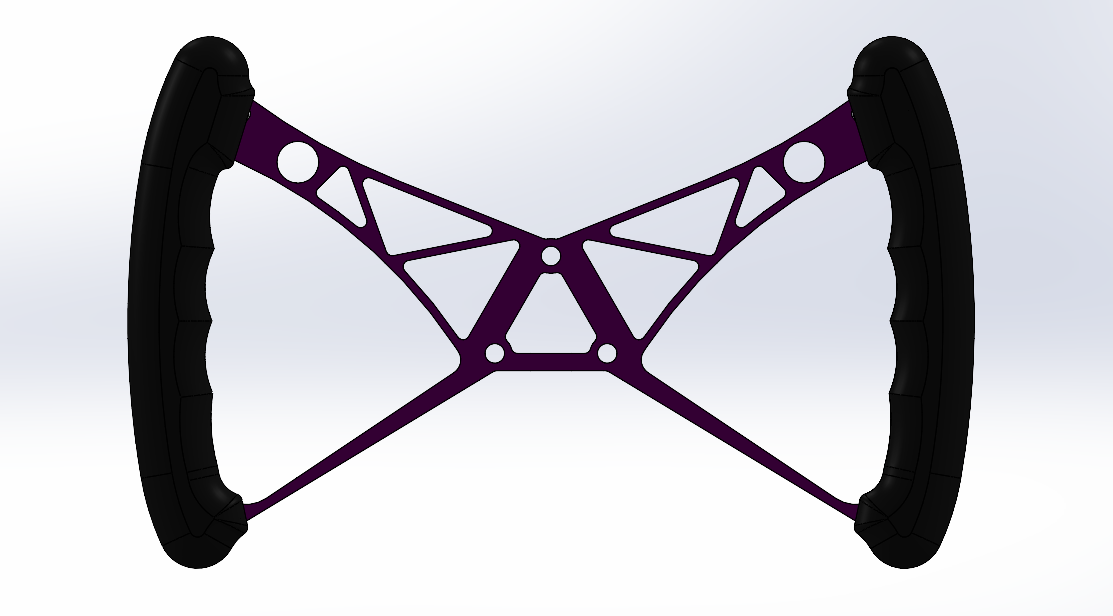
This project aims to design a lightweight, ergonomic, and durable steering wheel for the Baja SAE 2025 vehicle.
The design focuses on improving driver comfort while minimizing mass through optimized geometry and material
selection, with a particular emphasis on a machined aluminum structure. Manufacturing options such as CNC milling
and laser cutting are evaluated against cost, manufacturability, and stiffness requirements.
Project Goals
• Improve driver ergonomics and steering comfort.
• Reduce steering wheel mass to contribute to an overall 8% vehicle weight reduction.
• Ensure the wheel can safely withstand up to 20 kN of force transferred through the steering system.
Current Design Progress
We have progressed smoothly into the next phase of the aluminum steering wheel project. After completing our initial
evaluation of last year’s design, we ran structural simulations using a 600 N applied force which represented the driver’s full
body weight acting on the wheel to assess stress distribution, deformation, and overall structural integrity. These results,
shown in the simulation images below, helped us identify regions where the wheel was overbuilt and carrying unnecessary
material.
Stress Analysis
Quantifying where von Mises stress concentrates under a 600 N steering load to confirm an adequate safety margin against yield.
Under the 600 N load case, the von Mises stress field shows that the highest stresses occur around the spoke–hub junctions and along the inner edges of the rim where geometry changes are most pronounced. Even in these regions, the peak stress remains below the aluminum yield strength, providing a comfortable safety factor for competition use. Most of the rim and central webbing remain in the lower end of the stress scale, indicating that the primary load paths are well supported and that the thin, pocketed regions are not overstressed. Overall, the 2024 steering wheel demonstrates structurally sound behaviour with localized stress concentrations that are acceptable for the expected operating conditions.
Displacement Analysis
Measuring overall steering wheel deflection under the 600 N load to verify stiffness and preserve precise steering feel.
The displacement results show maximum deflection at the outer rim, particularly near the hand contact regions opposite the support points, with values on the order of roughly 1.5 mm according to the color scale. Deflection decreases smoothly toward the spoke–hub region, confirming that the central structure is effectively constraining the load. This level of rim displacement is small enough that it should not noticeably degrade steering response or driver confidence, while still allowing the structure to flex elastically and absorb some energy under peak loading. Overall, the displacement behaviour suggests that the 2024 design achieves a good balance between stiffness and material efficiency.
Strain Analysis
Examining strain distribution through the rim and spokes to ensure deformation stays within the elastic range of the aluminum.
The strain plot indicates that the highest strains develop near geometric transitions—such as fillets, pockets, and the spoke–rim interfaces—while most of the rim and webbing remain in lower strain bands. Peak strain values are on the order of 2.7×10⁻³, which is consistent with elastic behaviour for the selected aluminum alloy and comfortably below levels associated with low-cycle fatigue or permanent deformation. This confirms that, under the 600 N loading scenario, the steering wheel deforms in a controlled, elastic manner, and that the pocketing and cutouts in the 2024 design do not introduce excessive strain concentrations that would threaten long-term durability.
Through additional research and comparison with other steering wheel designs, we confirmed that last year’s frame was already quite optimized in terms of lightweight performance. For this reason, we preserved the core structural geometry but selectively removed excess material in regions that showed low stress during simulation. This refinement allowed us to reduce the total mass of the steering wheel by 12.42%, all while maintaining a safety factor that prevents aluminum deformation or yielding under expected loads.
Our Solution Based on the 2024 Steering Wheel Analysis
The simulation results revealed that both the central hub region and the upper web carried significantly lower stress compared to the surrounding geometry. This indicated an opportunity to safely reduce mass without compromising stiffness or load-carrying capability. Consequently, our remodeling strategy targeted these low-stress zones, shaving off excess material to create a lighter yet equally robust steering frame.
Moving forward, our next step is to run a full set of FEA simulations on the redesigned steering wheel to verify its stiffness, stress distribution, and overall safety margins. Once these results are reviewed and approved by our team lead, we will transition into the manufacturing phase, where the optimized geometry will be fabricated and prepared for integration with the vehicle.